Tag: Toolbox-studio

  • “Make heads turn our way,” Jewelfie said. And we did!

    “Make heads turn our way,” Jewelfie said. And we did!

    Jewelfie: Digital Video Case Study

    Introduction

    Jewelry features prominently in Indian culture. Associated with tradition, heritage and prosperity, jewelry is something most if not all households in India have. According to the Indian Brand Equity Foundation, jewelry accounts for 6-7% of India’s GDP, and over 500,000 jewelry-based businesses plying their trade here.

    It is not an industry, however, that is known to leverage the digital space to any great degree, or had not been one until Jewelfie came along. Developed by Prorigo, the Jewelfie Customer Engagement and Relationship Management (CERM) platform has brought the process of jewelry retail into the 21st century. Through the harnessing of augmented reality and visualization tools, the software allows prospective buyers to “Try-On” jewelry virtually, from personal computers, mobile phones and kiosks. This allows those shopping for jewelry online to gauge how the products will look on them without having to physically travel to the store and try each item on.

    Challenge

    Since the concept is a novel one, Jewelfie needed a digital video production to convey the process of using Jewelfie in a simple, straightforward and relatable manner to its consumers. They called on us here at Toolbox Studio to help make this happen. The idea was to engage our digital video production services in the creation of a short audio-visual that would convey all the benefits of Jewelfie, and walk the viewers through the actual act of using the software.

    Solution

    Toolbox Studio is a digital video production company that provides a variety of AV solutions for clients, and the in-house team suggested an approach that would draw viewers in and arrest their attention throughout the step-by-step process of using Jewelfie. The solution was an animated explainer video with arresting visuals, clear directions and graphics and animations to guide viewers through ‘the Jewelfie experience’.

    Approach

    The only way to approach a project such as this is through understanding, communication and cooperation between the client and us. This ensures that the client is completely in the loop from the ground up, and is involved in the creation of the content from its inception all the way, until it takes its final form. Here is the process in a little more detail

    1. Step one – Script: The script is a written representation of what the final video would look like. It lays down the groundwork and provides the structure for the whole procedure. The script was aligned to the needs of Jewelfie, what they hoped to achieve from this content, and factors such as intended viewer demographics, medium of publishing the content, and more were taken into consideration.
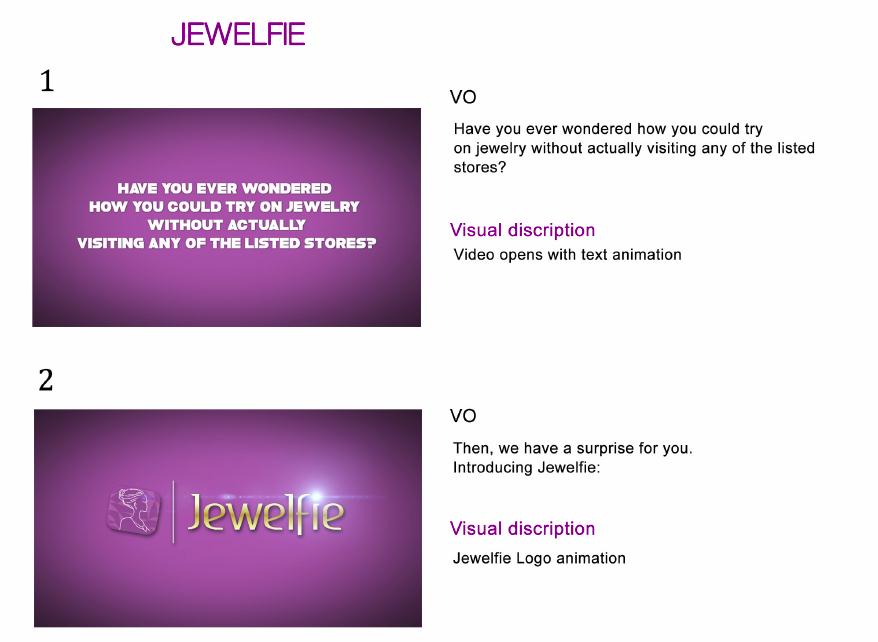
    jewelfie Script

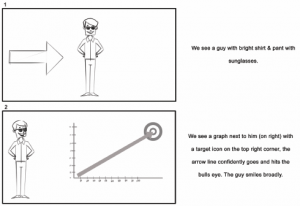
    1. Step two – Storyboard: Based on the script, a panel-by-panel storyboard was created to help Jewelfie understand how the visuals would play out in the final production. Digital renderings of the frames were prepared, and accompanied by a first draft of the voice over that would accompany each frame, along with a brief text describing the action in each frame. This was the client’s first real look at the visuals, and they had the opportunity to suggest any tweaks or changes in this initial stage itself. 
    1. Step three – Voice-over: Once the content for the voice-over was finalized, Jewelfie were given the opportunity to sample a variety of different vocals with choices of accents, speech styles, quality of voices, and other auditory choices so they could pick what they felt was the best fit as the voice for their product. Once the choice was finalized, the voice-over artist hit the recording booth and what you hear now is the finished product.
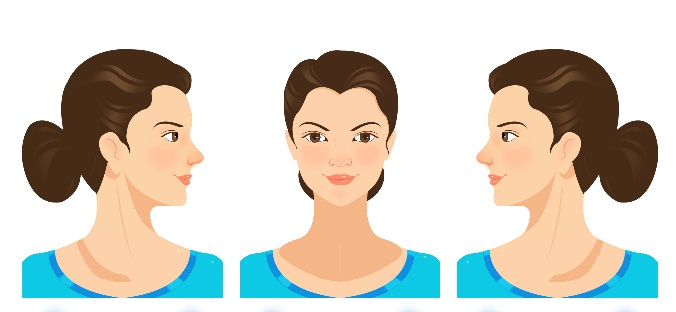
    jewelfie voice over

    1. Step four – Outline: The character that finally made it to the video first came to animated life during this step. A rough clip was provided to the client to allow them to see how the AV would look like. This included all the text, graphics and effects that would tie the whole video together. The feedback received here would be interwoven into the final iteration of the video, so this step was extremely crucial.
    1. Step five – Background Score: Music accentuates the visuals and provides flow, support and a more wholesome feel to the production. So selecting background music was the next step after the outline animation was given the green light by Jewelfie. The client was given various options to choose from, in terms of the background music, and the one that seemed to fit in with the visual most was finalized upon.
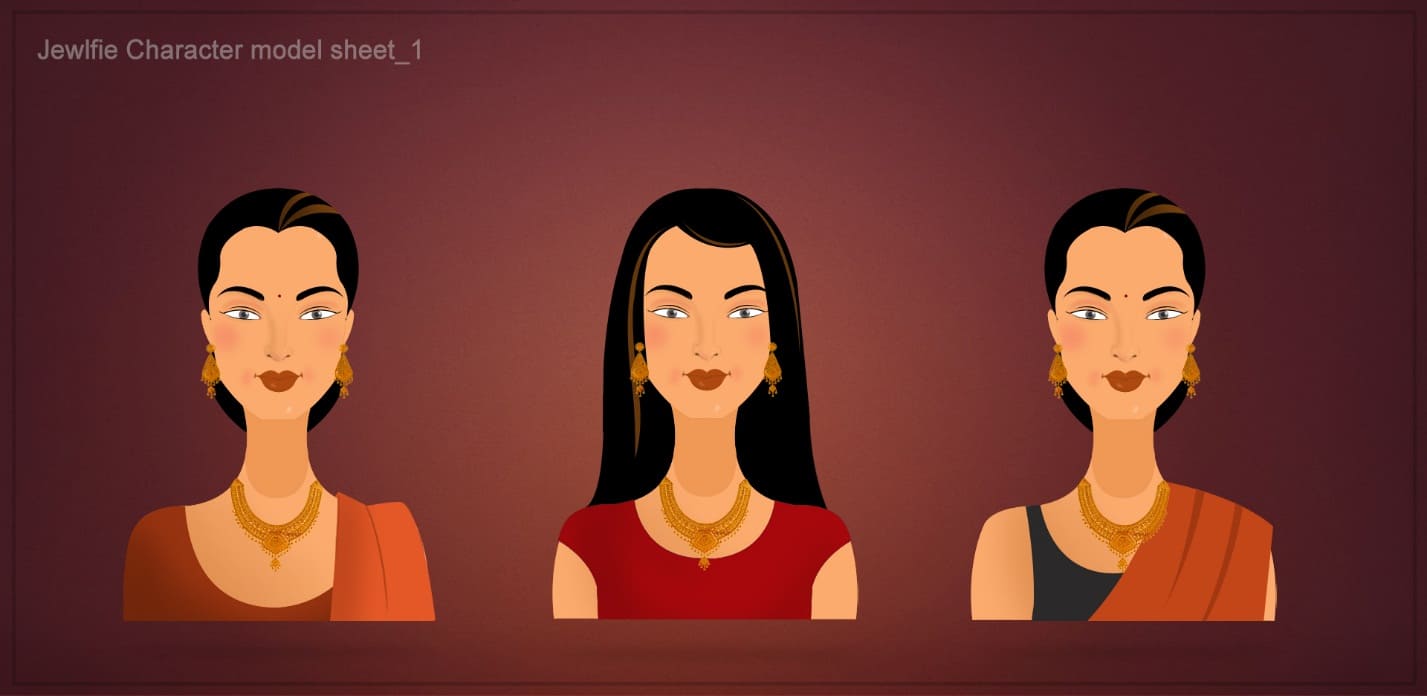
    jewelfie background source

    1. Step six – Final video: An amalgamation of the previous steps, the final video was the fruit of all the labor put into this production. As soon as the video begins, it immediately alludes to the world of the jewelry and foreshadows what services the product provides. Next, Jewelfie is introduced as a brand, with a prominent frame establishing the logo. A pleasant sounding and simple explanation both establishes the service provided, and explains how Jewelfie works to the viewers. The visuals and accompanying animation and voice-over provide a comprehensive insight into what Jewelfie can do, and ends with a message that reinforces the brand.

    Result

    The end result was an animated video that was visually appealing, grabbed the viewers’ attention, and provided a complete insight into the brand and what it brought to the table. Jewelfie is a groundbreaking company in terms of the products and services it offers, so it was essential to get the message out to Indian audiences in a way that they could relate to and understand. The video Toolbox Studio produced for Jewelfie did just that.

    Watch the video!

    You can watch the video here, and see for yourself the content we delivered for Jewelfie and what the production looked like after it had gone through all the steps we explained above. 

    Contact Toolbox Studio

    Has your company capitalized on the digital video marketing trend yet? Contact us to know how we can do for you what we’ve been doing for our illustrious clients for over 9 years. And keep an eye out on this space for more such awesome case studies!


  • H&R Block Case Study: A Simplified Digital Video on A Serious Subject

    H&R Block Case Study: A Simplified Digital Video on A Serious Subject

    Introduction of H&R Block Case Study 

    HR block

    H&R Block is a tax filing and solutions firm that has been present in India since January 2012. The company dates its origin back to 1955, when it was originally founded in the United States. Boasting of over 2.5 crore clients the world over, it is the largest H&R tax filing entity in the world. The company has been making large strides in India as well, with collaborations with more than 300 corporates (and counting), and over three lakh tax returns already filed.

    The Challenge of H&R Block Case Study 

    H&R Block needed digital video production content to populate on their website – content that would engage and attract potential customers and users, and present H&R Block in a positive light. This particular video was required to highlight the functions of H&R Block, and its primary service on offer – helping individuals file their income tax returns.

    The Solution of H&R Block Case Study 

    The solution provided by our team at Toolbox Studio was an explainer video, using production techniques to help present the content in a straightforward and easily graspable manner. The aim was to create a video that would not only comprehensively cover all the needs of the clients, but also do it in a way that did not alienate viewers – a challenging task (considering the subject matter). After all, in isolation, taxation is not the liveliest nor the most engaging subject out there!

    The Approach of H&R Block Case Study 

    Creating an animated video production is a complex undertaking, and Toolbox Studio works with its clients every step of the way to ensure that their needs are being addressed and the final product not only matches their expectations but also surpasses it.

    To this end, here are the steps that were undertaken from the beginning to the end of this particular project:

    1. Script

    After the brief was received from H&R Block regarding what they were looking to achieve from the video, who their target audience was, and where they wanted to publish the content, a script was prepared. The script is a textual description of the dialogue and accompanying visuals in the order it will appear in the final video. 

    Writing Script

    1. Storyboard

    The next step in the process was the creation of the storyboard. This involves actually sketching out the pertinent frames of the narrative to provide the client with a visual context of how the final production will appear. Everything from the lead characters, to the graphics involved, and the actions performed throughout the video were portrayed here for H&R Block’s perusal. 

    1. Voice Over

    Recording the Voice Over (or VO) was the third step in this production. A VO plays a very important role in the video. It provides key aural narratives and drives the audio aspect of the audio-visual production. Everything from the accent, to the style of speech, language, pitch, and timbre are important. Various pertinent choices were offered based on the needs of this particular video, and a decision was made by H&R Block regarding which one they preferred.

    1. Outlined Animation

    After the voice over is decided upon and recorded, an outline of the final animation is created. At this stage, H&R Block had the opportunity to see exactly what the final product would look like, and make any changes they needed to the content and its presentation. 

    1. Background Music

    After the animation was approved, it was time to make the final touches. The most important of which is the addition of a background music score (BGM) to the production. The background music sets the tempo of the production and adds another layer to it. Potentially awkward silences are filled in, and the score provides a complement to the VO, underscoring it when presented to the viewer.

    Background music

    1. Final output of H&R Block Case Study

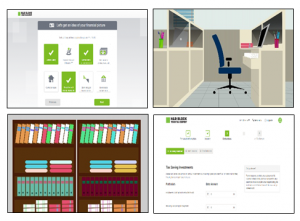
    Only after a suitable background music was selected and added to the production was the final video complete. The video begins with a light-hearted take on taxation and the trouble it gives people, portrayed through the animated lead character. Next, viewers are given a step-by-step guide through H&R Block’s taxation support service, while highlighting salient features (like the availability of live chat). The fact that the service is free of cost is also highlighted, and the video ends by reminding viewers of the client’s brand and forte.

    Watch the H&R Block Tax Chat and Tax Pledge videos to see the final output for yourself!

    The Result of H&R Block Case Study

    At the end of the process, H&R Block had a video that achieved the preset goal – a production that conveyed how easy it was to pay taxes through the medium of a fun, attention-retentive animated short video, which simplified the content, yet provided all the necessary information to the viewers. The content was still the most important aspect of the video, but it was presented in a manner that would make it more receptive to those watching it.

    Has your brand invested in digital video marketing yet? It is one of the top trends in the industry right now, and if you are steering clear of this brand-building and advertising machine, it is time to rethink. Contact us to know how we can do for you what we’ve been doing for our beloved clients over the last 8 years. And keep an eye out on this space for more such awesome case studies along with insights on why content (the message) is king even in case of video marketing.

  • How Toolbox Made UNindian Happen

    How Toolbox Made UNindian Happen

    What do you get when you combine a romantic plot with a cricketing heartthrob and exotic locales Down Under? Why, a recipe for a blockbuster, of course! In a major shift in roles, Aussie fast bowler Brett Lee made a smooth transition from 22 yards to 70 mm as the lead actor in Anupam Sharma’s cross-cultural drama, UNindian.

    Who knew that the second fastest bowler in the history of international cricket – one who evoked fear and awe in his opponents when he ran down the pitch, one who rattled the best batsmen with one piercing look, one who was famous for single-handedly dismantling the choicest of his rival teams – would one day be wooing a beautiful girl on screen? Who knew that Binga, as he is fondly referred to by his teammates, would one day be mouthing dialogues like, “Alright, educate me! How do I pick up an Indian chick?”

    Yes, he featured in a hit single with none other than the legendary Asha Bhosle way back in 2006 during the ICC Champions Trophy in India. And he also featured as himself in Victory, a cricket-themed film starring Harman Baweja. But this time, he’s the spearhead (like he was for the Australian team for so many years).

    So, what made him step into a completely different role from what he has been used to for so many years? What made him choose this particular film to begin his new journey?

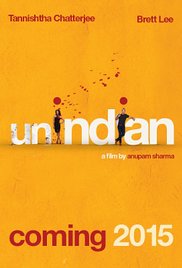
    UNindian Cover

    According to Lee, it was his love for India that made him choose the film. Well the cricketer, nay actor, is known for his love for the country that began all the way back in 1994 during his first trip here. Over the years, his love for India and ties with the country grew stronger.

    Given his good looks, it was only a matter of time before offers from Bollywood started pouring in, but Lee refused them as he wasn’t ready. By the time the chance to do this Indo-Aussie cross-cultural rom-com came his way, he was ready and raring to go.

    The Plot 

    UNindian is the story of Meera (Tannishtha Chatterjee), a beautiful Australian woman of Indian origin who is divorced and lives in Sydney with her daughter. Despite being an independent woman and a single mother, she is under intense family pressure to find a “nice Indian boy” to settle down with.

    Enter Will (Brett Lee), the tall and blonde teacher whose job is to introduce migrant students to basics of Aussie English and culture.

    He rides a bike, has Indian friends, plays Holi, and is a genuinely nice guy. Soon, Meera finds herself unable to resist Will’s warm smile and easy charm. But where she comes from, falling in love with an Australian is a complete no-no. Or rather, it’s unIndian.

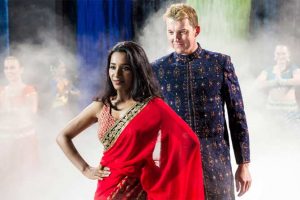
    UNindian Movie

    So, what does Meera do? Acquiesce with her parents or follow her heart? Does love triumph over tradition? That’s what UNindian is all about. In an interview with The Guardian before the release of the film, Lee said, “Anyone who watches the film will find at its heart the best of messages. Love has no boundaries. Love. You can’t help who you fall in love with.”

    The Challenges

    Admittedly, the movie created a lot of buzz as any film that debuts a cricketing hero should. However, most of the buzz was around Brett Lee and his transformation from a good-looking cricketer to an actor. Interviews galore with Lee and his experience with making the film preceded and followed the release of UNindian.

    What did not get as much attention (as it should have) was the work that went behind the scenes, the work that made the film what it was, the work that gave UNindian some of its most memorable scenes.

    Toolbox Studio was one of the major players in the behind-the-scenes action. The Pune, India-based media services company was hired to work on some of the film’s VFX. Our team at Toolbox worked on crowd multiplication shots as well as dynamic effects.

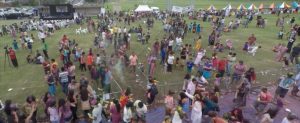
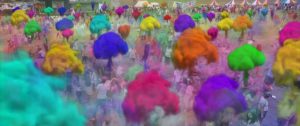
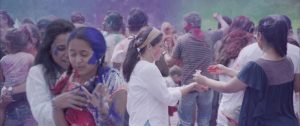
    They helped create the Holi scene where Will meets Meera for the first time. The team at Toolbox was given the task of adding dynamic colour effects to the sequences.

    UNindian VFXUNindian Mashroom VFX

    In some scenes, colors were not used during the shooting, but actually added by the Toolbox team as the mushroom blast effect which represented the Holi color effect. These beautiful colors were digitally created by their team. They used path-breaking VFX technologies such as 3D particle simulation to create the Holi color as well as the dust and particle effects.

    The team was also given the task of combining the sequences shot on green screens with the footage of the rest of the crowd and then adds the actors into the scene.

    UNindian Color VFXUNindian Background VFX

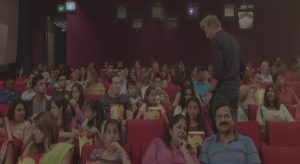
    Another wonderful sequence our team worked on was the movie theater crowd multiplication. When the crowd that used to fill up the theater by the director turned out not enough, we shot new footage at our own facility at Pune using local actors.

    This sequence was also shot in a green screen room. Afterwards, the green screen was removed and the footage of these actors was added in the existing shots. The team was able to combine two different footages shot at two different locations in two different time zones to perfection.

    UNindian Film VFXUNindian Film VFX_2

    So much goes into making a film and there is so much more to a movie than its glittering star cast. Ask anyone at Toolbox and they will tell you it requires hours of labour to create a two-second visual effect in a movie. But they will also tell you that it is an absolute blast (no pun intended)!

    The film is set to be released across theatres in India very soon. If you haven’t watched the trailer yet, here it is: https://www.youtube.com/watch?v=0QMRiv9a7uI

  • Revealing the Real Story Behind the Iron Throne

    Revealing the Real Story Behind the Iron Throne

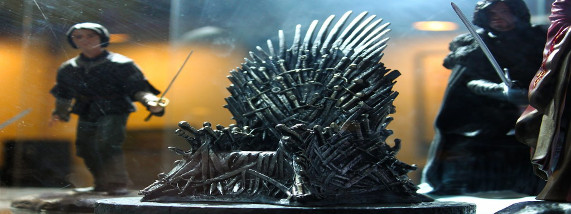
    April 17, 2011 marked the coming of winter. HBO’s Game of Thrones brought George R.R. Martin’s ‘A Song of Ice and Fire’ to life and introduced us to the opulence and grandeur of the seven kingdoms.

    The series aired its sixth season on April 24, 2016, and has continued to live up to the glory of the literary masterpiece, thanks to visionary creators David Benioff and D.B. Weiss, a brilliant ensemble cast, and outstanding VFX (Visual Effects).

    Game of Thrones is filmed at several surreal locations including Northern Ireland, Croatia, Morocco, Spain, Scotland, Iceland, Malta, and the United States. The dreamlike sets make up for only a small part of the magic that we see. Behind the green-screen are a bunch of phenomenal maestros sitting on their well-deserved iron thrones with technology that never fails to intrigue.

    Season 1 saw the incredible introduction to G. R. R. Martin’s fantasy world. HBO hired a British and an Irish company for the visual effects.

    Here’s a quick look at the extensive hours of work: https://www.youtube.com/watch?v=gcqY2AFNa08

    Games-of-Thrones-VFX-Breakdown                                                                                             Source: http://www.cgchannel.com

    Season 2 had increasingly challenging visuals, and HBO brought on board the expertise of a Germany-based visual effects company. The studio won the Primetime Emmy Award for the Outstanding Special Visual Effects in 2012 and 2013 for the episodes Valar Morghulis and Valar Dohaeris, respectively. They created the majestic armies spread across the screen, backgrounds with extended cityscapes, BG matte paintings, CG gore (blood splatter, anyone?), crowd simulation, and of course the juvenile dire wolves and dragons.

    GoT Season 2                                                                               Source: https://bananascoop.files.wordpress.com/

    Other Canada, US and Britain-based studios were involved in the making of the third season. Doug Campbell, one of the VFX supervisors, spoke candidly about his experience during Season 3. “The Ice Wall was one of the most compelling sequences for us. The 3D build provided the camera range required to deliver the drama and fear of the climb, and of course, the realism of the ice slide.”

    GoT Ice Wall                                                                                    Source: http://vignette3.wikia.nocookie.net/

    A 700 ft. wall (a few miles long, real-world scale) was created and the ice slide was simulated, and shot from several different cameras. Comprised of over 80 shots, the sequence exhibited the hold-on-to-your-seats sort of adventure, without compromising on the scale or continuity.

    The entirety of The Wall – 3D environment could rise to breathless heights on the shoulders of the quixotic experts. And it would be so unfair if we didn’t mention the enormous Mance Rayder’s camp and the 3D Unsullied Army!

    GoT Season 4_1                                                                                               Source:: http://winteriscoming.net/

    GoT Season4_2                                                                                         Source: http://blog.fidmdigitalarts.com/

    By Season 4, the audience and expected VFX magic had grown considerably; so had the dragons! HBO signed on a Germany-based firm that bagged the Emmy Award for Visual Effects in 2014 (for the season finale). A couple of Canada- and US-based studios also contributed to the season’s production.

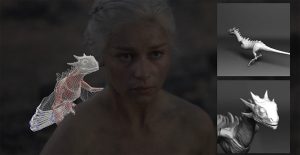
    A team of 22 to 30 people worked on understanding and conceptualizing Daenerys Targaryen’s dragons. Talk about attention to detail! What resulted was a string of stunning results with the muscle movements of the adolescent dragons in Seasons 4 and 5.

    GoT_DrogoniHD                                                                                       Source: http://vignette4.wikia.nocookie.net/

    The collision, destruction, and grandiose of the Harpy, the golden statue in Meereen, was a visual delight and the highlight of Season 5. A VFX supervisor at the VFX studio that worked on the fifth season said, “This was a huge CG build and complex work for TV. It is challenging because we’re aiming for feature film quality, but the schedule is not the same as on features. We built on last year’s work… Needing close ups of the pyramid meant we had to build it up brick by brick. Every brick was modelled and textured independently.”

    With (VFX Supervisor across the series) Joe Bauer’s work at the foundation, the VFX team worked on adding complexity and life to the CG scenes.

    Season 5 gave us the incredible matte paintings across Meereen, the ruins of Old Valyria, the Smoking Sea, and the Stone Men. While we are still settling into the unsettling and unnerving Walk of Atonement, the unveiling of tedious facts and relentlessly-dedicated processes of producing these heart-wrenching visual effects, continues to celebrate the work of the studios devoted to creating Game of Thrones.

    With Season 6 proving to be an overwhelming experience, especially with the much-awaited ‘Battle of the Bastards’, it’s a long wait until the final season comes knocking on our doors. Until then, we can keep reminiscing the seasons gone by and drool over the visual effects!

    Which was your favorite VFX sequence from the series? Let us know in the comments section below!