Tag: 2d animation

  • Hybrid Animation and How It is Making an Impact in the Animation Industry

    While 2D was the purer and the original form of animation, advancements technology gave rise to the slicker and more well-rounded 3D style. The former is charming yet a little less engrossing, the latter is more engaging but can get a bit much. Both are great forms of animation and with their widespread prevalence in media today, be it ads, films, music videos or television series, animators have started thinking out of the box.

    Hybrid 2d 3d animation definition

    2D animation refers to the process of creating motion in a two-dimensional space. It is a traditional animation technique that has been used for decades to bring characters, objects, and environments to life on screens both big and small. In contrast to 3D animation, which involves creating a three-dimensional digital environment, 2D animation focuses on the manipulation of flat, two-dimensional images.

    In traditional 2D animation, each frame is hand-drawn or digitally created by artists. These individual frames are then sequenced together in rapid succession to create the illusion of movement. This method of animation has its roots in traditional hand-drawn cel animation, where transparent sheets called cells were used to create each frame. With the advancement of technology, digital tools and software have become popular for creating 2D animation, allowing for more flexibility and efficiency in the process.

    The core principle behind 2D animation is the concept of “keyframes” and “in-between frames.” Keyframes represent the significant poses or moments in the animation, while in-between frames are the intermediate frames that connect the keyframes, creating a smooth transition between them. Animators carefully craft these frames, paying attention to details such as timing, spacing, and movement, to bring the characters or objects to life with believable motion.

    This creative approach to animatronics has given birth to hybrid animation is a blend of the sensibilities of both two-dimensional and three-dimension styles.

    What is hybrid animation

    Hybrid animation refers to the blending of different animation techniques or styles to create a unique and visually engaging result. It combines elements from various animation approaches, such as traditional hand-drawn animation, computer-generated imagery (CGI), stop motion, or even live-action footage. The goal of hybrid animation is to leverage the strengths of each technique to enhance the overall visual storytelling.

    How Does Hybrid Animation Work?

    Hybrid animation is the blending of 2D and 3D animation thus, mixing two and three dimensions in the same frame to offer a unique visual perspective. 2D animation is traditionally known as hand-drawn or analogue animation, even though you can easily render in 2D on computers, and many creators do this today. The principle is still the same though. Each shot is created frame by frame in sequential order and then these images are placed in a timeline to create motion as it were.

    3D animation can be created using stop-motion and clay models or puppets, or can be entirely computer-generated using software such as Maya, 3DS Max, Blender, Houdini and Flash.

    As we mentioned earlier, the perspectives offered by the two disciplines have their own distinct visualizations, so creating an animation that utilizes both is quite challenging. But when executed well, the results can be absolutely breathtaking. There are different approaches one can take while blending these too, like having the background in 2D besides giving a 3D treatment to the protagonist or primary character or vice versa.

    The Impact of Hybrid Animation – Two Great (and well-known) Examples

    Here are two extremely famous examples of hybrid animation, that showcase how both these approaches can be taken.

    The Iron Giant –

    Created in 1999, this Warner Bros. Sci-Fi animation has become a bit of a cult classic today. Based on a 60s novel by the same name, the film has some huge names for voice characters including Vin Diesel for the Giant, Jennifer Aniston, Harry Connick Jr and more. It is a charming tale of the friendship between a boy and a giant metal robot of sorts. Another great example of visual storytelling can be seen where the Iron Giant takes the exact opposite approach to Spirit (see below). Here, the backgrounds are rendered in 2D while the main characters are all three-dimensional.

    A quote from the film’s director (making his debut) and legend in animation circles today – Brad Bird – explains why this approach was taken and more of that in this archived Warner Bros ‘making of’ page for the movies. He says, “It is difficult for a human to draw a big, solid metallic object. Animators excel at drawing movement and living, fluid objects. The giant originates from a different world, so we chose to create the giant using computer animation, CGI, which would give him the mass and solidity and also give the impression that it’s from a different place. The separation between the 2D-animation and the CGI is something that helped establish the fish-out-of-water facet of the story.”

    While The Iron Giant swept home, nine awards at that year’s Annies (the top animation awards), the film itself didn’t get a great reception at the box office, largely due to WB’s lack of promotion. Though today, it is revered as one of the great examples in animated feature film history and is rightly lauded for its unique approach.

    Check out the trailer of its re-mastered version:

    Spirit: Stallion of the Cimarron –

    This 2002 DreamWorks animation was set in the American Wild West in the 19th century and follows the adventures of the titular character, Spirit, a Mustang colt whose inner monologue is voiced by Matt Damon. It tells a story of immense leadership, courage, and friendship, as its themes. The film was nominated for an Oscar for best animation and is an absolute visual treat. Spirit uses lush, colourful 3D backgrounds, but the primary characters are all hand-drawn in traditional 2D style.

    A document written by Doug Cooper, the Digital Supervisor at DreamWorks Feature Animation explains the approach, saying, “The primary character in “Spirit” is a traditionally drawn 2D animated horse, which inhabits the richly detailed tapestry of the American Wild West at the turn of the century. The heavy use of 3D sets and camera moves brought an extra challenge to the traditional animators in needing to precisely match the sometimes subtle and slow perspective changes that occurred throughout a shot.” Fascinating, isn’t it?

    Here’s the trailer of the film so you can see what the final result was:

    These are just two seminal examples of an underrated-yet-prolific form of animation. While the challenges posed by this type of hybrid animation mean, it isn’t the most widely-used approach, the creators who dare to be brave may end up with a visual masterpiece akin to these two fine examples on their hands if they do venture in this direction.

    At Toolbox Studio, we are great proponents of novel approaches and techniques involved in filmmaking, especially when it comes to animation for films, television, advertisements and web productions. Take a look at our selection of some of the best animation projects we have worked on.

  • 2D, 3D, ‘2.5’D Animation & 5 Good Reasons to Create Animated Videos

    2D, 3D, ‘2.5’D Animation & 5 Good Reasons to Create Animated Videos

    Animated explainer videos have become an extremely popular form of communicating marketing messages to consumers because they can do so in an entertaining and engaging format.

    However, the effectiveness of animated explainer videos is by no means a blanket effect. Not all explainers will translate into popular and engaging pieces of content. Multiple factors guide an explainer’s path to success or obscurity. These factors include the visual quality of the animation, the script and story, choosing the right voice-over artist, and even the music used in the video. Each of these factors can make or break the video. Because there is no one-size-fits-all formula for the success of explainer videos, you can only ape what your competition is doing and hope that your video will turn out as effective, too.

    The most important decision that decides the popularity of an animated video is the format through which you choose to have it created. 2D, 2.5D and 3D are the choices you typically have in front of you, and each method of rendering the animation has its own individual traits.

    To help you decide which one would be the right fit for you, here is a breakdown of what each brings to the fore:

    • 2D Animation

      The simplest form of animation, 2D, is effective in various scenarios. While the visual is flat, meaning it lacks a bit of dynamism, the flat plane results in a format that causes less strain to the viewer’s eyes. 2D is excellent when using a character to tell a story or turning something like a static infographic into an engaging video. It isn’t the best medium to depict complexities or deeply technical visuals, but keeping things sweet and simple is excellent. Here is a short 2D animation (Toolbox Studio’s very own 2D animation production showreel) that showcases the medium’s qualities and versatility

    • 2.5D Animation

      2.5D animation, as the name suggests, lies somewhere between the 2D and 3D space. It is a form of animation that relies on 3D objects placed within a 2D environment. This means that typically, while the background is flat, the hero subject of the video is in 3D. It creates an intriguing effect that, when harnessed correctly, can add a different feel and texture to the video. And, of course, typically, 2.5D isn’t as expensive to create as a fully-fledged 3D animation, either. Here is a quick example of 2.5D animation.

    • 3D Animation

      The top dog of the animation world, 3D videos are the most visually immersive of the lot, thanks to the additional feeling of depth they bring to the screen. 3D animations can explain even the most complex subjects in an incredibly detailed and delightful way. Of course, this depth and level of detail comes at a price because 3D is usually the most expensive form of animation. Please take a look at our profoundly immersive and painstakingly detailed 3D animated short to understand the medium’s potential.

    Now that we know the different types of animated videos, here is how they can help businesses big and small in their marketing efforts.

    5 factors that make animation the perfect medium for marketing explainer videos

    1.Letting the creative juices flow

    The limitations of the natural world don’t restrict animation. The laws of physics, for example, don’t necessarily apply, so your characters can do all sorts of amazing things that aren’t possible in live-action videos.

    2. Conveying messages with brevity

    Using animation, you can simplify what you need to say and let the visuals do the talking. You don’t need to rely on voiceovers or physical movements to help convey your message; the animation itself conveys the message for you. This means you can say more in a shorter span of time, and in this day and age, when viewers lose interest so quickly, this is crucial because every second counts.

    3. Demystifying complex technical processes

    If your business involves highly technical processes that you want your viewers to understand, then animations are the way to go about it. You can show a fully functioning cutout of your complex mechanics to simplify it, and provide a running commentary, and slow down or speed up the action based on how difficult or easy it is to understand.

    4.Breaking away from the monotony

    There is a reason why animations are so popular among children and adults alike – they are just plain fun to watch! After the tedium of watching a barrage of live action ads on a daily basis, an animated explainer makes for great visual relief. It can be darker than the darkest set or brighter and more colourful than anything else we can replicate in the real world. As long as you can think it, it can be done, and this is what give animation the upper hand in terms of entertainment value.

    5. Cost effective

    Animations are a whole lot cheaper to develop than a comparable live action video. Even 3D animation, which is the most expensive kind, is much cheaper than making live action videos. This is because animation doesn’t require the hiring of a set, actors’ fees, props and set design, video shooting equipment, lighting, permits or anything of that sort. Furthermore, any tweaks that need to be made to the animation are easy and not costly. Re-shooting even a single scene, on the other hand, will involve a whole round of investment.

    We should know, after all, Toolbox Studio is an animation studio! If you aren’t able to pick your favorite type of animation, contact us and we’ll show you our demos and help you understand what types of animated videos can help you communicate your brand’s message in the best possible way.

    An animated explainer video company can help you add a new dimension to your business by reaching out to your target audience on an emotional level and delighting them visually!

  • Animation and VFX…what’s trending?

    Animation and VFX…what’s trending?

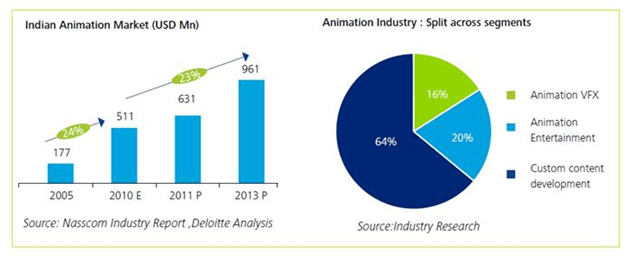
    What would a movie like Avatar be without animation and VFX? Absolutely nothing. It is the magic of animation and VFX that makes the impossible…virtually possible! Though the Indian Animation and VFX industry is still nascent, it is estimated to grow at a whopping 30% annually for the next three years, resulting in a $15 billion industry.

    Vfx and animation trends
    Animation vfx trends in India

    While the focus always has been more on animation, VFX too is growing by leaps and bounds. There has been a significant increase in the amount of VFX used in movies as well as in television shows. Usage of VFX saves a considerable amount of money for the producers. Creating sets, especially for mythological shows is a costly affair and VFX helps in reducing these costs by around 60-70%. No wonder that the Indian producers are relying more on VFX nowadays.

    The animation and VFX industry has transformed and emerged as one of the most sought-after professions, as well as the dire need of the media industry. And the transformation doesn’t stop here. The animation industry growth in India keeps upgrading itself with the latest technology, tools, software…and keeps producing wonders after wonders.  Here’s a glance at what’s trending…

    The Bengal Tiger in the movie ‘The life of Pie’ is a perfect example of the combined magic of technological advances and natural talent. The animators marvelously created a tiger that seemed so real, it seemed hard to believe that they need not stage a real tiger for the shoot.

    Motion Capture Technique is the latest and has already created a lot of buzz. James Cameron’s Avatar successfully used this technique coupled with CGI (Computer Generated Imagery) which set a trend in the film making industry. In this technique, the actors wear skin-tight suits with markers attached to them which reflect beams of infrared light and are sent to a special camera system. The movements are then captured and are then transferred to a virtual character. If you wish to have a sneak peek  into the animation techniques used in Avatar, here’s the link.


    Rajnikant’s upcoming movie Kochadaiyyan has made use of motion capture technology and is one of the most awaited films. It would be interesting to see how this Indian movie fairs in comparison with Avatar.

    Many would opine that the Indian Animation Industry is not up to the mark when it comes to the comparison with Hollywood animation movies. But did you know, major animation studios and producers from all over the world are turning to India to outsource their projects? India is considered to be cost effective, and more importantly,   India is believed to provide world-class animation.

    The Lion King, Finding Nemo are a few of Hollywood films with Indian expertise. So why are Indian films.

    Watch out for the Indian animation industry. It’s all set to capture your imaginations and set a new high!