Category: Film VFX

  • 7 DIFFERENT WAYS YOU CAN USE ROTOSCOPY ANIMATION TODAY

    Like everything else in the world, rotoscopy has its own timeline of evolution.

    The Evolution of Rotoscopy and Animation

    This was the age when motion pictures were a rage! The early animators started making films that were nothing but a series of moving drawings. That is how Animation was born. It was around this time in 1915, that rotoscopy animation was first heard about. Max Fleischer made a series of movies named Out of the Inkwell, the earliest example to the concept. He would make his brother perform the movements of Koko The Clown and film it. And then would the trace over it frame by frame to produce the realistic effect in the movie. This was the new standard for all animated movies making that Max a pioneer in animation set. And it was just the beginning. Many early cartoons where later produced using this technique. One of the most remembered is Betty Boop in the 1930’s whose various movements including the hula hoop was captured using rotoscoping in film. Changes made to text

    Till time passed into the mid-20th century, it was still only used to bring more complex movements of humans or animals to the screen. However, in the 20th century, rotoscoping in film became more prominent as production houses started using it in numerous large scale productions. Walt Disney used the rotoscoping technique in the making of larger movies like the Snow White and the Seven Dwarfs. Beatles used it make the video of the track the Yellow Submarine. And many animated movies followed suit. The reason rotoscopy animation wasn’t used extensively is that it was very difficult to do. Every movement had to be traced over frame by frame and a steady hand was needed to accomplish this. Without a perfect trace, the image would come out wobbly. This is used today to a more stylish effect at times but it wasn’t taken into consideration a lot back then.

    Then the modern times arrived and the computers began to take over. The rotoscope animation was becoming a thing of the past but the rotoscoping technique stood its ground. The first two in the most notable of list were the movies Walking Life and Scanner Darkly. There have been many movies that have followed and used this technique to create captivating results. But what can you do different with rotoscopy animation?

    Inspiration: What Can You Do With It Today

    The first of showings was with the Beatles and their track Yellow Submarine. It was a wave. They changed the very way people viewed music not only for their generation but also the generations to come. But that wasn’t all. They also contributed what was among the very first music video made using rotoscopy animation. Here is a list on what has been tried since then!

    Tron: The legacy

    It is a movie but it is one of a kind. Rather is among the few first ever made of the kind!

    https://www.youtube.com/watch?v=6HcsDc_9LX8

    Lord of the Rings cartoon 1978                   

    It is a cartoon like so many more but stands out owing to the exceptional work done with the rotoscopy. Take a peek. The characters movements are so human that it simply cannot be missed.

    https://www.youtube.com/watch?v=6WcJbPlAknw


    But why limit yourself to movies or cartoons, when you can do so much more! Here are a few unforgettable music videos that adopted the same technique.

    Take Me Home – Never Gonna Stop

    This music video was made for the band Take Me Home. Whether you have heard the song or not, the video is a must watch for any admirer of rotoscopy and animation.

    https://www.youtube.com/watch?v=DGx-5A3onb0

    You Got Me Up – Jamie Lidell

    Another music video we admit, but the cat and its attempts to escape are as realistic to look at as possible!

    https://www.youtube.com/watch?v=O0h0pvjVSzo


    And their is still more that you can do.

    Guns In The Film Noir

    How do you show violence without showing too much violence? Rotoscopy!

    https://www.youtube.com/watch?v=89QnMwfWn9g


    Detective Story

    Why limit yourself to a short movie? Why not try out a few short animations? That is exactly what was done. Another short animation from Film Noir.

    https://www.youtube.com/watch?v=_3EXWtZ6n8U

    Video Game Avatar

    Why stop with just a short animation? Go a step further and make a game!

    https://www.youtube.com/watch?v=KHPPahbt2Ig


    Any other ideas on how you can use to rotoscopy animation to create something different? Do tell us!

  • Metamorphosing Marathi Cinema: The VFX Factor Revolutionizing the Industry

    Marathi films have witnessed a stupendous growth in the last decade, not only in the number of audience visiting the screens but also in technology that has taken the whole experience of watching a Marathi film to an all new level. The films today are far beyond the typical slapstick comedies and are more logical and futuristic. When we say futuristic, we don’t mean that they are delivering something at par with Hollywood but at least the thinking and the approach is right. And who knows, in the coming years they might reach that level too.

    The movie ‘Shwaas’ really pumped some oxygen into the ‘about to die’ Marathi film industry.  It broke the clichéd boundaries and made Marathi people visit the screens to watch the movie. Such has been the transformation after Shwaas that multiplexes today are not hesitating at all in providing screens for a   Marathi film and even non-Marathis are going to a multiplex to watch a Marathi film which is good and has subtitles. Films like Fandry have even gone beyond this and have made their mark at various International Film Festivals and have been successful in creating a huge fan base. Just check out the Facebook page of Fandry and you will be amazed at the response it has garnered. And one thing that many of us won’t have noticed is that Marathi films have been winning National Awards on a consistent basis since the last few years.  Unbelievable, isn’t it? But the big question is… what has brought this transformation? Of course, logical and out of the box scripts, good direction, better music and lyrics are the obvious answers.  But what really skips our mind is the main reason that a film ‘catches our eye.’ The Visual Effects!

    Marathi film producers are more open to innovation now and they have understood the importance of VFX in a film. In the Marathi Film Industry where the budget has always been a constraint, the producers are now reserving a good amount to be spent on quality VFX.  Because every penny spent on VFX eventually generates an output that’s worth a much more!

    Who would have imagined that someday a movie like ‘Aajoba’ which is based on the life of a leopard will be made in Marathi? But today such movie has not only been made but it has garnered rave reviews as well.  Films like Pune 52, Pitruroon, Time Please, and Salaam have impressed not only on the script level but have appealed visually too. And the common name behind the movies listed above has been …Toolbox Studio!

    Toolbox Studio, Pune is one of the best studios serving customers for films, post production and animation technology. With an imaginative eye, it offers top-quality VFX and CGI for Films, Titles, Commercials and more. Toolbox Studio animation studio is proficient in handling full length feature film VFX, and it provides additional value to commercials, promos, and TV commercial with its unique VFX team. Right from pre-visualisation to 3D asset modelling, 3D animation, rotoscopy, matte painting and compositing…Toolbox Studio nurtures every element with the best expertise available resulting in the final output to be worth applauded. While you must be wondering about these terms and how Toolbox Studio is exceptionally good at it, let’s try and resolve your doubts.

    • Pre-visualisation: Interpreting the director’s vision, understanding the spectrum of film making, knowing the in and outs of camera and lens selection and understanding the importance of lighting in storytelling is of utmost importance. And Toolbox Studio with its in-house team and live action endeavours does it the best!
    • 3D Asset Modelling: At Toolbox Studio, they create 3D assets such guns, vehicles and many imaginary 3d models according to directors vision. Toolbox makes visualization easy for you by making tailor made 3d assets. Thus Toolbox is first choice of directors.
    • 3D Animation: VFX is a combination of live action shoot and animation. Toolbox Studio with its on-set supervision, concept art imagery yet realistic characters and high quality animation at an affordable cost makes it easy to come out with the best VFX.
    • Rotoscopy: Rotoscoping is an animation technique in which animators trace over footage, frame by frame, for use in live-action and animated films. Toolbox Studio utilizes every available global digital technology in an effort to make its services cost effective while focusing and delivering the highest possible creative and effective approach to film vfx.
    • Matt Painting: A matt painting is visual representation of any given place, real or imagined, that is too expensive to recreate or far away to visit. Such artworks are necessities in creating realistic backdrop for films. Toolbox has created breath taking matt painting for lot of film projects.

    Compositing: compositing is about making complex, visual masterpieces driven by director’s creative vision. With its master compositors, Toolbox Studio delivers more value to its clients. With dedicated resources and team of visual effects artist it specializes in 2D, 3D and stereo compositing that includes-

    • Green screen compositing
    • Motion graphic design
    • Set extension
    • Beauty enhancement
    • Paint

    Toolbox Studio has been contributing quite outstandingly, not only to Marathi films but also for International films since 5-6 years. Movies like Pune 52 and Pitruroon have enthralled the audience with their visual effects and have proved to be a benchmark to look up to. And the credit goes to the Toolbox Studio for creating the curiosity and the eagerness to watch these films right from the day the trailer was launched.  And same is the case with Toolbox Studio’s other creations like the very much acclaimed movie Salaam, Time Please, Koknastha to name a few.  And there are more in the making like ‘Gurupournima’ and ‘Baaji’, which will surely take the industry to an all new level

     Toolbox Studio has enabled films to be technically strong and it has fetched much better results for them in terms of appreciation.  And going by Toolbox Studio’s portfolio and the hunger of the Marathi film industry to grow, one can’t really expect anything less than ‘world class’ in the years to come!

  • Animation and VFX…what’s trending?

    Animation and VFX…what’s trending?

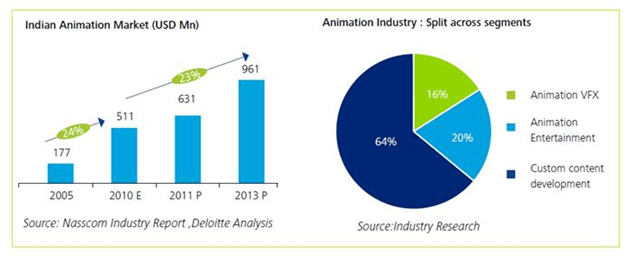
    What would a movie like Avatar be without animation and VFX? Absolutely nothing. It is the magic of animation and VFX that makes the impossible…virtually possible! Though the Indian Animation and VFX industry is still nascent, it is estimated to grow at a whopping 30% annually for the next three years, resulting in a $15 billion industry.

    Vfx and animation trends
    Animation vfx trends in India

    While the focus always has been more on animation, VFX too is growing by leaps and bounds. There has been a significant increase in the amount of VFX used in movies as well as in television shows. Usage of VFX saves a considerable amount of money for the producers. Creating sets, especially for mythological shows is a costly affair and VFX helps in reducing these costs by around 60-70%. No wonder that the Indian producers are relying more on VFX nowadays.

    The animation and VFX industry has transformed and emerged as one of the most sought-after professions, as well as the dire need of the media industry. And the transformation doesn’t stop here. The animation industry growth in India keeps upgrading itself with the latest technology, tools, software…and keeps producing wonders after wonders.  Here’s a glance at what’s trending…

    The Bengal Tiger in the movie ‘The life of Pie’ is a perfect example of the combined magic of technological advances and natural talent. The animators marvelously created a tiger that seemed so real, it seemed hard to believe that they need not stage a real tiger for the shoot.

    Motion Capture Technique is the latest and has already created a lot of buzz. James Cameron’s Avatar successfully used this technique coupled with CGI (Computer Generated Imagery) which set a trend in the film making industry. In this technique, the actors wear skin-tight suits with markers attached to them which reflect beams of infrared light and are sent to a special camera system. The movements are then captured and are then transferred to a virtual character. If you wish to have a sneak peek  into the animation techniques used in Avatar, here’s the link.


    Rajnikant’s upcoming movie Kochadaiyyan has made use of motion capture technology and is one of the most awaited films. It would be interesting to see how this Indian movie fairs in comparison with Avatar.

    Many would opine that the Indian Animation Industry is not up to the mark when it comes to the comparison with Hollywood animation movies. But did you know, major animation studios and producers from all over the world are turning to India to outsource their projects? India is considered to be cost effective, and more importantly,   India is believed to provide world-class animation.

    The Lion King, Finding Nemo are a few of Hollywood films with Indian expertise. So why are Indian films.

    Watch out for the Indian animation industry. It’s all set to capture your imaginations and set a new high!